What's New in Doc-To-Help 2009?
- Built-in XML-based Editor - This new feature truly makes Doc-To-Help a self-contained Help Authoring Tool. Doc-To-Help still has the flexibility and customizability that our customers love but now there is no need to use a third party software package to create and edit your content. Plus there is no need to learn complicated programming languages.
- Easy Conversion from Other formats to XHTML - Doc-To-Help users can easily bring their content into the 21st century by converting existing Word and HTML files to XHTML without formatting issues or a lengthy migration process. Whatever content your customers have, Doc-To-Help can handle it.
- Dynamic Help Control - The Help Author will love that they can integrate a Help file into an application with and an easy "point and click" instead of using complicated code strings. The Developer will love it because they don't have to integrate the Help into the application programmatically, which is an extra step that can cause problems.
- Import/Export of All Project Settings - Doc-To-Help now supports automated project modifications. This feature makes Doc-To-Help even easier and more intuitive.
- Supports ANY HTML Editor - not just Dreamweaver and FrontPage
- Drag and Drop Topic Linking - The ability to drag topics from the Topics grid or keywords from the Index and Groups panel and drop them into Word or ANY HTML editor makes the latest version of Doc-To-Help even more intuitive and easier to use.
What's New in Doc-To-Help 2008?
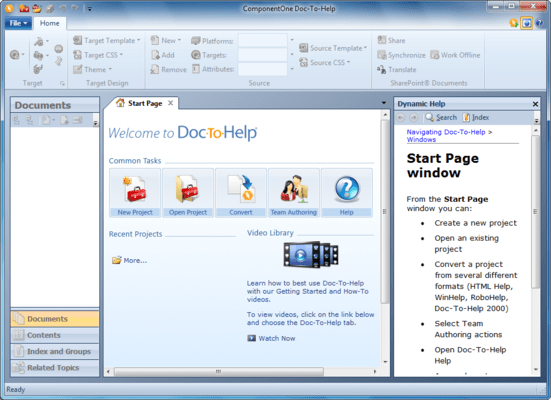
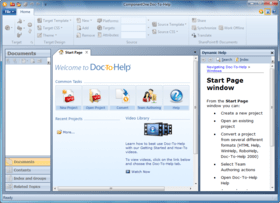
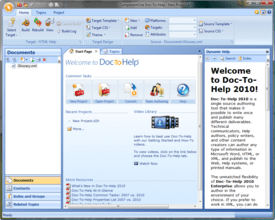
Doc-To-Help 2008 has a completely redesigned, contemporary user interface:
- Office 2007-style Ribbons have replaced menus.
- The Properties Panel is gone - all configuration and settings are managed with the ribbons or within dialog boxes.
- You can edit your source or target Cascading Style Sheets using the new Style Editor.
- Complex Conditions - You can assign three different conditions to a topic, document, or text: Platform, Target, or Attribute - giving you more single-sourcing options.
- The Topic Grid is significantly improved to allow you to see and edit many topic properties at once.
- Outlook-style Accordion tabs have replaced the Icon bar.
- The tabbed interface makes it possible to have multiple windows open and easily accessible at the same time.
- You can create custom topic relationships using the Related Topics Editor. This makes creating links to "See Also" topics quick and easy.
- The Dynamic Help window displays help topics automatically as you navigate the interface.
What's New in Doc-To-Help 2007 v3?
- Support for XHTML Output: Users can now generate an XHTML version of NetHelp, HTML Help, Help 2.0, and JavaHelp targets. The XHTML output conforms to the W3C XHTML 1.0 transitional specification
- New D2H toolbar button for inserting DemoWorks movies: Doc-To-Help now has a new Flash Movie toolbar button in the Microsoft® Word Doc-To-Help toolbar that allows a user to import and insert a Flash movie object into online output. This button was not added to HTML editors because they already have this feature built in
- Expanding/Collapsing Sections: Doc-To-Help has drop-down text, but it is for a single drop-down instance. If you would like to subdivide entire topics into collapsible sections, use the new Expanding/Collapsing Sections feature, which allows you to define collapsible sections with a special style
- XML Transforms:Users can now add transforms to XHTML output to manipulate content.These transforms can be .NET or XSLT
- Extensive Improvements to Sandcastle Functionality
- Added CodeBlock and PostTransform components
- D2HML hot spots in XML comments in source code
- XSLT transformation of the source code comments XML
- Exclude elements without description
- Special styles to easily create links from narrative parts to the reference part
- Source template C1H_sandcastle_src.dot and the toolbar "Doc-To-Help - Sandcastle
- Added "Enable sending feedback" check box and Company name/email text boxes
- Added "Copyright text" text box
- Option to select Word format when creating documents:There is a new property, WordDocFormat, that allows Microsoft® Word 2007 users to set the .docx format as the default for Manual Targets
What's New in Doc-To-Help 2007 v2?
- Text Variables: Doc-to-Help users will be able to re-use and re-distribute blocks of text across a project. Any change to the original block of text will then be reflected across the project.
- Rich Content Variables: Similar to Text Variables, it will allow the user to save content blocks that contain graphics, tables, and styles, and then re-use these topics across a project.
- Sandcastle Integration for Documenter for .NET: Documenter for .NET will now integrate with Microsoft's Sandcastle to quickly, easily, and more efficiently scan .NET assemblies and .dlls to create MSDN-style reference documentation.
What's New in Doc-To-Help 2007 v1?
- JavaScript enabled NetHelp: Doc-To-Help 2007 v1 adds a JavaScript search option (adding the to existing Java search). This option uses technology that requires no setup or installation of Java utilities. It will work as soon as you produce the output
- Bread crumbs added to all HTML outputs: Breadcrumbs are a popular way to help end-users keep track of their location in a Help file. Doc-To-Help's HTML-based outputs (NetHelp, HTML-Help, HTML 2.0) now include this navigational element. Additionally, Doc-To-Help's breadcrumbs can be removed and are fully customizable
- Generate PDF button in Word: Doc-To-Help produces printed manuals in .PDF and/or Word format. With Doc-To-Help 2007 v1, you have the choice to either generate the .PDF directly from Doc-To-Help or from a generated Word manual. This gives you the opportunity to format your manual before you generate the .PDF
What's New in Doc-To-Help 2006v3?
- Team Authoring Support (Enterprise Edition Only):
- Ready to use out of the box. No setup required.
- Step-by-step wizard shares and connects to the projects for you.
- Choose whether you would like to share the project via File System (for local networks) or Web (for remote users).
- User Interface gives a visual representation of documents’ status.
- Convenient toolbars provide easy access to Team Authoring functions, such as check in, check out, get latest version from repository, and refresh view.
- Automatically keep all projects synchronized.
- Direct to PDF Output:Generate a PDF directly from your Doc-To-Help progress.
- New Vista Inspired NetHelp (web-based Help) Theme
- New NetHelp Features: added convenient features to NetHelp including, email topic, print topic, and a favorites tab.
- Document Conditions:Set conditions on the document level for single sourcing. With the addition of this feature, you can now set conditions on the text, paragraph, topic, and document level.
What's New in Doc-To-Help 2006v2?
- More Linking Options: Choose more specific targets for topic links, such as bookmarks and document names
- Better Command Line Support: Execute a variety of tasks from the command line, as well as schedule builds
- More Flexible Publishing: Specify any location as the output folder of a Help target
- Improved Search Results in NetHelp: NetHelp now highlights search terms in search results
- Improved Developer Support: Use your own XML tags in comments when automatically generating .NET reference documentation
- Section 508 Compliance: Create output that meets Section 508 federal regulations
What's New in Doc-To-Help 2006 v1?
RoboHelp Converter Enhancements - The RoboHelp converters have been made even more robust by adding more advanced RoboHelp project elements. With Doc-To-Help 2006v1, these RoboHelp project items will be converted:
- Conditional Build Expressions
- Single Source Layouts
NetHelp Project Merge - Many organizations have multiple projects from multiple authors that need merged into one. Doc-To-Help 2006 includes functionality that seamlessly merged multiple NetHelp files into one.
General NetHelp Enhancements - Doc-To-Help 2006 makes a few important enhancements to NetHelp such as a menu for multiple links and a noise list for NetHelp search.
Live Links in Manual - Doc-To-Help 2006 gives you the option of creating live links for your printed manual output.
Documenter for .NET Enhancements - Doc-To-Help 2006 includes two enhancements for Documenter for .NET:
- Links for Standard Framework Types in Help 2.0
- Support for Non-Standard XML Comment Tags (Supported by nDoc)
What's New in Doc-To-Help 2005 v2?
- Macromedia Dreamweaver Integration (Enterprise Only)
- Import RoboHelp Word Projects
- Import Any WinHelp Project
- Doc-To-Help Express
- Context Sensitive Help for Web Applications
- Live Update Utility
- Unicode Support
All the single-source Help authoring features you need
Doc-To-Help gives you every feature you need to create fully functional and customized Help files and printed manuals from a single source document, or set of documents. Use basic features, such as Topic Jumps and Pop-ups, or more advanced features like Conditional Text and Context Sensitive Help.
Author HTML and configure Help systems in the editor of your choice
Doc-To-Help allows you to author content and configure your Help systems in your favorite editor. You simply apply pre-defined styles to your content and Doc-To-Help uses that information to create your Help systems. This eliminates the need for a proprietary editor or proprietary code.
RoboHelp project converter
Convert RoboHelp projects to Doc-To-Help format with one click.
Unmatched Support and Subscription Services Doc-To-Help Platinum includes a subscription that delivers free updates, telephone and e-mail support for a year.
Doc-To-Help Enterprise and Doc-To-Help Word main differences:
Doc-To-Help Enterprise includes:
- Team Authoring Support
- Macromedia Dreamweaver Integration
- Microsoft FrontPage Integration
- Import RoboHelp HTML Projects
- Import Individual HTML Files
- Use Any HTML Editor
A document with all differences between Doc-To-Help Enterprise and Doc-To-Help Word Editions can be found in the 'Evals and Downloads' section.
Doc-To-Help 2007 Main Features:
Creating Help Systems and Printed Manuals (Features for Your Help Systems)
- Microsoft Windows Vista and Office 2007 System Support: Experience support for Windows Vista and the 2007 Microsoft Office System including Seamless Integration with Word 2007
- Single source authoring:Quickly and easily create and implement HTML Help, Cross-Platform HTML-based Help, JavaHelp, WinHelp, Visual Studio .NET-style Help, and printed documentation from one source document
- Graphics and Screenshots:Easily include images in your project
- Image Map Editor:Insert an image and add hotspot links to specific Help topics
- Links, jumps, pop-ups, and more:Add topic links and jumps, pop-up topics, dynamic links, and cross-references
- Dynamic Text Effects:Add dynamic text, such as expanding text, pop-up text, and drop-down text, to your Help files
- Table of Contents and Index:Doc-To-Help uses information from your source content to automatically create a customizable table of contents and an index
- Modular TOC Utility: Automatically populate all modular system Help files with fully functional table of contents links
- Glossary Terms: Use the convenient toolbar buttons or styles to add and sort glossary terms
- Natural Search: Add a Natural Language search engine to your output. Keyword search is also included
- Context Sensitive Help: Automatically generate context IDs, or specify your own, to map topics to your application's interface
- Context Sensitive Help for Web Applications: Automatically generate context IDs, or specify your own, to map topics to your Web application's interface. Help topics will appear in NetHelp, the Web-based Help output
- Context String Editor: Use a convenient interface to define context ID strings for Help 2.0 and conveniently connect them to Help topics without writing a single line of code
Use Existing Content (Convert files from RoboHelp, other tools, and Doc-To-Help 2000. Also import existing documents)
- RoboHelp HTML Project Converter (Enterprise Edition only): Import a RoboHelp HTML file and Doc-To-Help will automatically convert it to a Doc-To-Help project, complete with Doc-To-Help markups. All you have to do is point and click!
- RoboHelp Word Project Converter : Import a RoboHelp Word file and Doc-To-Help will automatically convert the project information and the Word source file(s).
- Import Any HTML Help Project: Import any HTML Help file and Doc-To-Help will automatically convert it.
- Import Any WinHelp Project: Import any WinHelp file and Doc-To-Help will automatically convert it.
- Doc-To-Help 2000 Converter: Easily convert your existing Doc-To-Help 2000 projects with the click of a button
- Import Individual Word Files: Import individual files containing single or multiple topics
- Import Individual HTML Files (Enterprise Edition only): Import individual files containing single or multiple topics
- Merge Multiple HTML Help and WinHelp Projects: Combine multiple projects into one TOC, index, and glossary
- Merge Multiple NetHelp Projects: Combine multiple projects into one TOC, index, and glossary
- Highlighted Search Results in NetHelp: When opening a topic found by NetHelp Search, the search phrase is now highlighted in the topic text
- More NetHelp Enhancements: A new NetHelp theme gives more functionality such as print/email topic and save-to-favorites to improve the user experience
Authoring and Editing Projects(Features to make your content creation process easy and flexible)
- Microsoft Word or HTML Source: Author your source documents in Microsoft Word, HTML, or both
- Microsoft Word Integration: Use the toolbar and wizards that install in the Microsoft Word interface to create online Help and printed documentation elements
- Microsoft FrontPage Integration (Enterprise Edition only): Use the toolbar and wizards that install in the Microsoft FrontPage interface to create online Help and printed documentation elements
- Macromedia Dreamweaver Integration ( Enterprise Edition only): Use the toolbar and wizards that install in the Dreamweaver interface to create online Help and printed documentation elements
- D2HML (Doc-To-Help Markup Language): Use D2HML to specify styles that translate into Help elements when Doc-To-Help processes the document
- Built-in or Custom Templates: Choose from a variety of templates for producing high quality print documentation. You can modify the built-in templates or use your own
- Built-in Styles: Use built-in styles for authoring "What's This" topics and mid-topic jumps. You can also use the built-in character styles to easily implement jumps, pop-ups, and index entries based on textual matches
- HTML Theme Designer: Use the theme designer to control the layout and appearance of topics for HTML-based platforms
- Conditional Text: Use Doc-To-Help's built-in conditional text styles to designate content for a specific output
- Team Authoring Support ( Enterprise Only): Source control technology provides integrated check-in/check-out functions so multiple authors may contribute to one project
- Conditional Build Expressions: Use a combination of conditional build tags to create advanced conditional builds
- Margin Notes: Add margin notes in Word with the click of a button
- Scripting: Create custom scripts and assign them to styles to develop your own features
- Output Folder Specification: Specify any folder as the output folder of a help target
Generating Help Systems and Printed Documentation (Features to empower you to create the outputs you need)
- Improved Command-Line Support: Build a Doc-To-Help project from the command line
- ComponentOne NetHelp (Cross-Platform HTML):Create a searchable Help system designed for deployment on the Web
- Popular Online Help Formats: Generate any popular Help system such as HTML Help, WinHelp, JavaHelp, and Visual Studio .NET-style Help
- Help 2.0: Software developers can use Doc-To-Help in conjunction with the Visual Studio Help Integration Kit (VSHIK) to develop content that integrates with the Help system in Visual Studio .NET
- Printed Documentation: Transform your Microsoft Word and HTML sources into professional printed documentation complete with a customizable title page, table of contents, index, and glossary
- Section 508 Compliance: Doc-To-Help creates a version of NetHelp that is Compliant with Section 508 of the US Rehabilitation Act
- Document Conditions: build tags allow the user to set conditional build tags for entire documents
- PDF Output: Automatically create a print-ready PDF manual and skip the manual-to-PDF conversion process
Application Developer Support (Features to support Web and Windows application developers)
- Documenter for .NET: Automatically generate MSDN-style internal and end user documentation. Documenter for .NET creates reference documentation from compiled assemblies and XML comment files, providing you with complete and well-formatted documents for class libraries Documenter now supports any custom user-defined tags and attributes in XML comments. This is done through an optional XSLT transformation that can now be specified in a Documenter project.
- Context String Editor: Define context ID strings and conveniently connect them to Help topics
- Visual Basic Scripting: Use Microsoft Visual Basic scripts to customize the behavior of individual styles at compile time
- Links to Standard Framework Types in Help 2.0: Generate links to system classes and types (those belonging to .NET Framework, such as System.String, etc)