Ensure Consistent Styling Across Documents
CSS compliance in structured document tools ensures accurate, consistent formatting for XML, HTML, and schema-based content across all outputs.
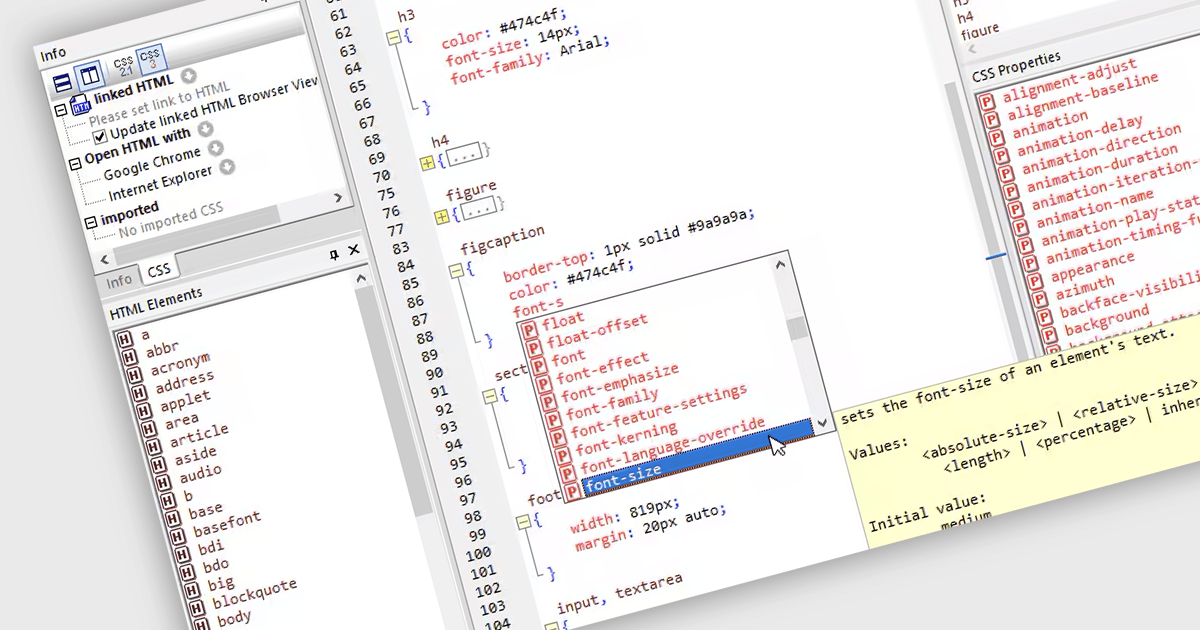
CSS compliance in a Structured Document Tool refers to the tool's ability to accurately interpret and apply Cascading Style Sheets (CSS) specifications to control the presentation of structured content such as XML, HTML, or other markup-based documents. This ensures that styles, layouts, and formatting defined via CSS are consistently rendered across different output formats, including web, PDF, and print. For software developers, CSS compliance simplifies the design process by enabling the reuse of standard web styling rules within document workflows, reduces the need for custom styling logic, and enhances interoperability with other systems and tools that rely on CSS. It also supports maintainability by allowing style changes to be managed centrally through CSS files, promoting efficiency and consistency throughout the content lifecycle.
Several Structured Document Tools offer CSS compliance including:
- Oxygen XML Editor by Syncro Soft lets you apply CSS styling to XML content, ensuring accurate formatting and consistent presentation acrrmats.
- Altova XMLSpy allows you to use CSS with structured documents, providing reliable control over layout and visual design.
- Liquid Studio by Liquid Technologies facilitates CSS-based styling for XML schemas and data models, supporting clear, standards-compliant document formatting.
For an in-depth analysis of features and price, visit our comparison of Structured Document Tools.