Released: Dec 10, 2025
Updates in 2025.11
Features
AI Assistant (Early Access Preview)
- TeamCity AI Assistant aims to help both beginners and experts, from offering general guidance on TeamCity concepts to delivering troubleshooting insights for misconfigured or failing builds.
New Build Steps
- In version 2025.11, JetBrains are bringing the familiar .NET build step to pipelines. Instead of one single step with dozens of settings that depend on the selected step command, pipelines split this build step into a series of task-specific units.
Project Registry Connections Support
- Starting with version 2025.11, Docker and NPM connections owned by projects are available as integrations in pipeline and job settings.
Advanced Build and Test Actions
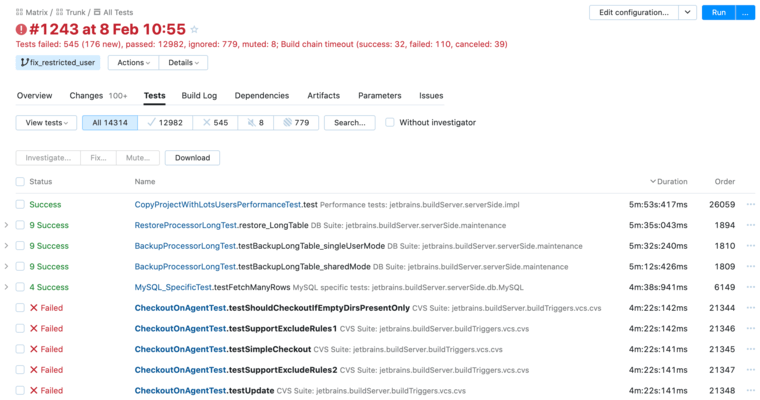
- Starting with version 2025.11, pipelines support some of advanced features that was previously available only in build configurations. Users can now process build and test failures: assign investigations, mute irrelevant failures, and manually label as fixed issues that are expected to be resolved in future builds.
Parameter Import
- Previously, a parameter owned by a project could not be used inside pipelines. Referencing such parameters would result in an implicit agent requirement: only agents that provide a value for this parameter were eligible to run this pipeline. Starting with version 2025.11, you can import any parameter from a direct or indirect project and use it as any other native pipeline parameter.
Reimagined Creation Flows
- Every new TeamCity journey starts with "New Project", "New Build Configuration", and "New Connection" pages. In version 2025.11, JetBrains are rethinking these pages for a faster, more intuitive creation process. Whether you are reusing an existing connection, sharing a VCS root, or creating a build configuration without a repository, everything you need is right at your fingertips.
New Pipeline and Build Chain Viewer
- Real-world CI/CD workloads often include dozens of build configurations and jobs that combine building, testing, and deployment tasks into a single flow. To make it easier to explore these complex workflows, TeamCity now offers an enhanced visualization that displays pipelines and build chains in a dedicated client that supports zoom and drag-and-drop, and features a minimap for easy navigation.
Miscellaneous Enhancements
- Updated the TeamCity License Agreement to align it with JetBrains standards (such as definitions, structure, etc.); it has been fully restructured to make it clearer, more user-friendly, and easier to navigate. There are no changes to TeamCity's business model or user rights to how to use TeamCity.
- The only material change is an adjustment of the liability clause, which now follows JetBrains standard approach used across other JetBrains products.
- Commit Status Publisher no longer posts intermediate failure statuses in the following cases:
- Build Failure Conditions include the support test retry option.
- Tests are run by the Gradle build step with the Gradle test retry plugin.
- Tests are run by the test or vstest command of the .NET build step with a Test retry count greater than zero.
- TeamCity now posts only the final test status, determined after all required re-runs. This prevents VCS statuses from displaying false alarms for failures that are automatically resolved on retries.
- The Miscellaneous section of the agent details page now includes the Dump memory snapshot on agent link that allows you to download an .hprof memory dump file.
- Parallel tests and Matrix build features now include the option to automatically place artifacts produced by virtual builds into separate folders. This prevents newer virtual builds from overriding artifacts with identical names produced by older batches.