

.NET News

Enforce Structured Input with Masked Editors

March 18, 2026
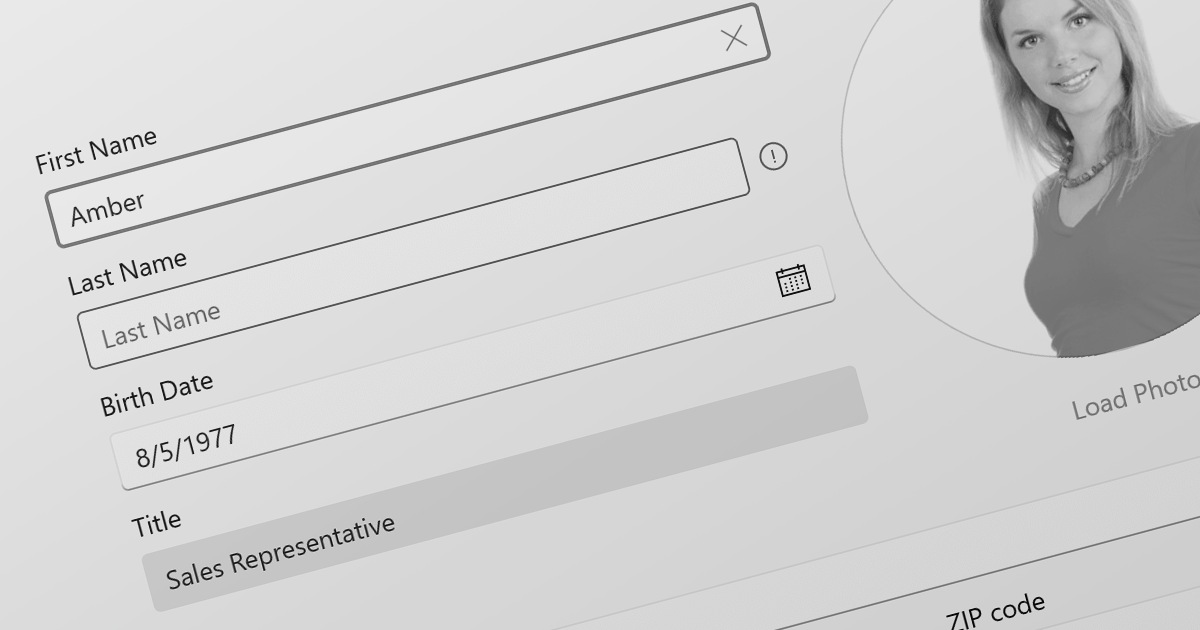
Masked input text box editors for .NET Blazor guide users to enter values in predefined formats, helping to capture consistent, validated data.

Masked Input Text Box editors are input components that enforce a predefined format while users type, ensuring that entered values follow a specific structure such as phone numbers, dates, postal codes, or identification numbers. By applying an input mask, the editor guides users to enter characters only in valid positions and formats, reducing the likelihood of invalid or incomplete data being submitted. This approach improves data consistency across applications, simplifies validation logic on both the client and server side, and reduces the need for additional parsing or correction of user input. For developers building data-driven Blazor applications, masked input editors help maintain reliable data entry while providing a clear and structured input experience directly within forms and data editing interfaces.

Many .NET Blazor data editor collections contain masked input text box editors including:

  • Telerik UI Blazor Data Editors (part of Telerik UI for Blazor) lets you enforce formatted user input with masked text boxes, ensuring consistent data entry for structured values.
  • ComponentOne Blazor Data Editors (part of ComponentOne Studio Blazor Edition by MESCIUS) allows you to apply input masks that guide users, improving validation accuracy.
  • Smart UI by Smart HTML Elements, facilitates structured data entry with masked input editors that restrict characters and enforce predefined formats during typing.
  • Infragistics Ignite UI for Blazor Data Editors (part of Infragistics Ignite UI) lets you implement masked input fields that ensure users enter values following required patterns.

For an in-depth analysis of features and price, visit our comparison of .NET Blazor data editors.

Compare .NET Blazor Data Editors

Enable PDF to Word Conversion in .NET

March 13, 2026
Provide .NET applications with the ability to convert PDF documents into Microsoft Word formats such as DOC and DOCX.

PDF to Word conversion is the process of transforming a Portable Document Format (PDF) file into an editable Microsoft Word document such as DOC or DOCX. This capability is widely used when content that was originally distributed in a fixed-layout format needs to be modified, reused, or incorporated into other documents. Converting PDFs to Word allows users to edit text, adjust formatting, and extract tables or images without manually recreating the original content. For developers and organizations that process large volumes of documents, automated conversion can improve productivity by enabling document reuse, simplifying content updates, and supporting processes that require editable formats.

Several .NET PDF components allow you to convert PDF to Word, including:

  • DevExpress PDF Document API for .NET (part of DevExpress Office File API) can extract text and images from PDF files, which can then be used to generate Word documents.
  • Aspose.PDF for .NET provides built-in functionality for converting PDF files directly to Microsoft Word formats such as DOC and DOCX.
  • GroupDocs.Conversion for .NET includes native support for converting PDF documents to Word formats including DOC, DOCX, and RTF.

For an in-depth analysis of features and price, visit our comparison of .NET PDF components.

Compare .NET PDF Components

Locate Information in PDFs with Keyword Search

March 13, 2026
Quickly find text using PDF search, helping users locate keywords, navigate documents, and access relevant content instantly.

Search in a PDF viewer allows users to quickly locate specific words, phrases, or data within a document without manually scanning each page. By instantly highlighting and navigating between results, search makes it easier to work with large or complex PDFs such as reports, manuals, contracts, or research papers. This functionality improves productivity by helping users find relevant information faster, understand content in context, and move directly to important sections.

Several .NET PDF Viewer controls allow you to search for text in PDF files including:

  • Telerik UI for .NET MAUI PDF Viewer (part of Telerik UI for .NET MAUI) lets you quickly search text highlight matches and navigate results across pages.
  • IronPDF for .NET by Iron Software allows you to programmatically search PDF text, identify keywords and extract relevant content.
  • ImageGear for .NET by Accusoft facilitates fast text search within PDF pages enabling applications to locate phrases highlight results and guide navigation.
  • GroupDocs.Viewer for .NET lets developers search text across viewed PDF documents quickly find matches and display highlighted results within applications.

For an in-depth analysis of features and price, visit our .NET PDF Viewer controls comparison.

Compare .NET PDF Viewer Controls

Capture Text Quickly with Speech-to-Text Input

March 13, 2026
Telerik UI for WPF and WinForms 2026 Q1 adds Speech-to-Text functionality enabling faster hands free input with live transcription.

Telerik UI for WPF and Telerik UI for WinForms are UI libraries for building Windows desktop applications. Telerik UI for WinForms includes more than 160 controls and a structured architecture with Composite UI Application Block (CAB) support, making it suitable for enterprise and data-heavy internal applications. Telerik UI for WPF is designed specifically for Windows Presentation Foundation (WPF) and provides a wide range of customizable, high-performance controls for complex line-of-business software. Together, the libraries provide ready-made components that help teams build and maintain desktop applications more efficiently.

The Telerik 2026 Q1 update for WPF and WinForms introduces a 'Speech to Text' button that enables developers to add voice input with real time transcription directly into their applications. This feature allows users to enter text faster through hands free interaction while providing immediate visual feedback on recognized speech as it is captured. Developers can customize the control’s appearance to match application themes and branding, choose between continuous or single recognition modes depending on the scenario, and integrate custom speech recognition services or libraries, making it easier to implement accessible, flexible, and efficient voice enabled data entry experiences.

To see a full list of what's new for each product in 2026 Q1, see our Telerik UI for WPF and Telerik UI for WinForms release notes.

Both Telerik UI for WPF and Telerik UI for WinForms are licensed per developer and have two licensing models: an annual Subscription License and a Perpetual License. The Subscription license provides access to the latest product updates, technical support, and exclusive benefits for a flat annual fee, and must be renewed to continue using the software. The Perpetual license is a one-time purchase granting access to the current released version and includes a one-year subscription for product updates and technical support. After this initial period, users can choose to renew the subscription element to continue receiving updates and support; otherwise, they may continue using the installed version available during their active subscription term but will forgo future updates and support. See our Telerik UI for WPF licensing page and Telerik UI for WinForms licensing page for full details.

Telerik UI for WPF and Telerik UI for WinForms are available individually or as part of the following products:

Find and Highlight Text Faster

March 13, 2026
LM-Kit.NET 2026.3.2 adds search capabilities that locate and visually highlight text in PDFs or images with exact, regex, and fuzzy matching.

LM-Kit.NET is a cross-platform software development kit (SDK) designed for .NET applications, enabling on-device execution of large and small language models without relying on external cloud services. It supports a broad range of natural language processing tasks, including text generation, translation, summarization, and entity recognition, executed locally on CPU or GPU, with compatibility across Windows, Linux, and macOS. The SDK provides native integration through a NuGet package, allowing developers to embed AI capabilities directly into desktop, server, or edge applications while maintaining full control over data, performance, and compliance requirements. It supports multiple model architectures and inference backends, giving developers flexibility to tailor performance and resource usage to their specific environments.

The LM-Kit.NET 2026.3.2 update introduces the SearchHighlightEngine, a new feature that enables applications to search and visually highlight text within paginated documents such as PDFs or images. It supports exact matches, regular expressions, and fuzzy matching using the Damerau–Levenshtein distance, allowing developers to locate text even when small spelling variations or recognition errors are present. The engine produces a highlighted version of the document, making results immediately visible and easier to review in document processing, analysis, or verification scenarios. It can also accept pre-computed PageElement instances for raster PDFs or images, allowing existing layout or text extraction results to be reused and reducing the processing required to add search highlighting capabilities.

To see a full list of what's new in version 2026.3.2, see our release notes.

LM-Kit.NET is licensed per deployed commercial application per year. The license is subscription-based and must be renewed every year to continue using the Software. See our LM-Kit.NET licensing page for full details.

Learn more on our LM-Kit.NET product page.